NIMASA, MWUN Begin Review Of Dockworkers’ Conditions Of Service For 2026–2028
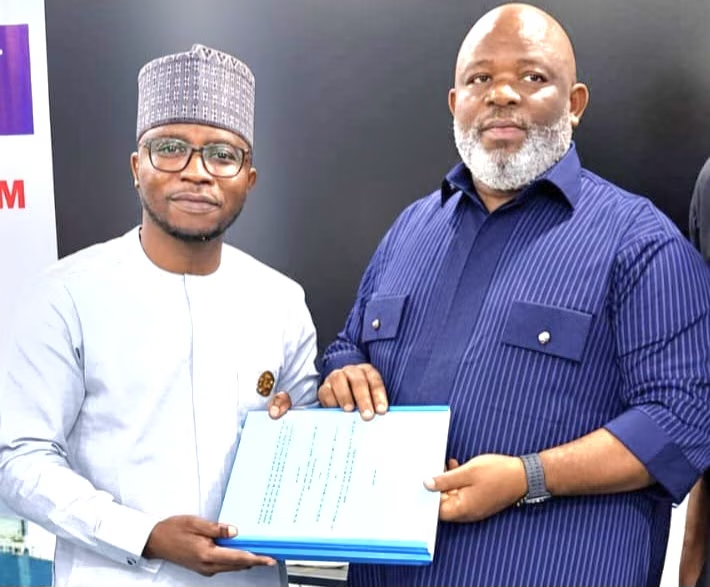
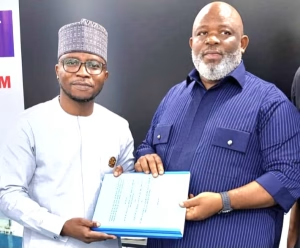
L-R: Executive Director Maritime Labour and Cabotage Services of Nigerian Maritime Administration and Safety Agency (NIMASA), Mr. Jibril Abba and President General of Maritime Workers Union of Nigeria (MWUN), Comrade Francis Bunu. During the National Joint Industrial Council (NJIC) meeting on the Review of the Minimum Standard for the Docklabour Industry 2026 - 2028 held in Lagos Nigeria.
 NIMASA, MWUN Begin Review Of Dockworkers’ Conditions Of Service For 2026–2028
…NJIC reconvenes as workers, employers table proposals on wages, safety, pension, welfare.
By Success Okezie
The men who carry Nigeria’s trade on their shoulders are about to get a new deal.
The Nigerian Maritime Administration and Safety Agency, NIMASA, and the Maritime Workers’ Union of Nigeria, MWUN, have commenced a comprehensive review of the minimum standards and conditions of service for dockworkers for the 2026–2028 period.
It is a review that will determine how much a dockworker earns, how safe he is at work, what pension awaits him at retirement, what protective equipment he wears, and what future his children can dream of.
And it began in Lagos, at the reconvened National Joint Industrial Council, NJIC, meeting facilitated by NIMASA — a meeting where employers, labour unions and other industry groups laid their proposals on the table.
The NJIC is not just another meeting. It is the structured platform where government, employers and organised labour negotiate the minimum conditions of service, promote decent work and strengthen industrial relations in the dock labour sector.
It is where the fate of thousands of dockworkers is decided — not by strikes, not by shutdowns, but by negotiation.
This time, the submissions were broad and weighty. They covered:
– *Wages* — what dockworkers should earn in a changing economy
– *Workers’ welfare* — the benefits that make life dignified
– *Occupational safety and health* — how to keep workers alive and healthy
– *Pension provisions* — what happens after years of labour
– *Working conditions* — hours, shifts, rest, and dignity at work
– *Protective equipment* — helmets, gloves, boots, life jackets, and all that stands between a worker and danger
– *Skills development* — training for a future driven by technology
These submissions, NIMASA said, will form the basis for further consultations towards establishing an improved and harmonised framework for the dock labour industry.
In other words, this is only the beginning. But it is a beginning that matters.
Speaking at the meeting, the Chairman of the NJIC, who is also the Executive Director, Maritime Labour and Cabotage Services, NIMASA, Mr Jibril Abba, set the tone with a message that dockworkers will not forget in a hurry.
He stressed that the welfare, safety and fair treatment of dockworkers remain critical to efficient port operations and the overall competitiveness of Nigeria’s maritime industry.
“Dockworkers are an indispensable part of the maritime value chain. Ensuring fair remuneration, decent working conditions, adequate safety provisions and opportunities for professional development is not only a labour issue but also fundamental to the efficiency and sustainability of our ports.”
Think about it: Every container that enters Nigeria passes through the hands of a dockworker. Every bag of rice, every car, every machine, every crate of medicines — lifted, moved, stacked, secured, and cleared by dockworkers.
Without them, the ports stop. Without them, ships wait. Without them, the economy stalls.
Abba said the review was necessary to address existing disparities in wages and employment conditions, strengthen compliance with industry standards and respond to changing operational realities driven by technology and evolving port activities.
The ports of today are not the ports of yesterday. Cranes are bigger. Ships are bigger. Technology is changing how cargo is handled. The conditions of service must change too — or workers will be left behind.
He urged all parties to approach the process with a shared commitment to fairness, mutual understanding and industrial harmony.
> “We must negotiate in good faith. We must listen to each other. We must remember that we are on the same side — the side of a stronger, safer, and more efficient maritime industry,” Abba said.
In his remarks, the President-General of the Maritime Workers’ Union of Nigeria, MWUN, Comrade Francis Bunu, commended NIMASA for providing a platform for sustained engagement between workers and employers.
But his commendation came with a clear warning: this process must deliver results.
He emphasised the need for the review to be concluded promptly and translated into tangible improvements in workers’ conditions.
“We appreciate NIMASA’s continued engagement with the maritime labour community. What is important is that this process delivers practical benefits to dockworkers. The agreement must go beyond words on paper and ensure improved welfare, better working conditions and sustained industrial peace in our ports.”
It was a message that resonated with every dockworker in the room — and every dockworker in Apapa, Tin Can, Onne, Port Harcourt, Warri and Calabar who was waiting to hear the outcome.
For too long, workers have heard promises. For too long, agreements have been signed and shelved. For too long, welfare has been discussed in air-conditioned halls while workers sweat under the sun at the terminals.
Comrade Bunu was saying: Not this time.
This time, the agreement must be felt in the pocket. It must be felt in the safety helmet. It must be felt in the pension account. It must be felt in the working hours. It must be felt in the dignity of the worker.
> “Our members are not asking for charity. They are asking for fairness. They carry the nation’s trade. They deserve a fair share of the nation’s prosperity,” Bunu declared.
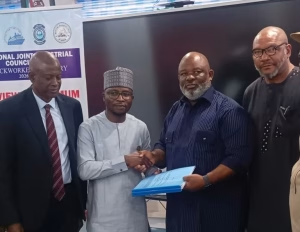
The meeting brought together all the key players in the dock labour ecosystem:
– *Seaport Terminal Operators of Nigeria (STOAN)* — the operators who run the terminals
– *Oil Producers Trade Section (OPTS)* — representing the oil and gas operators
– *Association of Bonded Terminals Operations of Nigeria (ABTON)*
– *National Association of Stevedoring Operators (NASO)*
– *Maritime Workers’ Union of Nigeria (MWUN)* — the voice of the workers
That all these parties sat at one table, under NIMASA’s facilitation, is itself a victory for industrial relations.
It means the industry is choosing dialogue over disruption. It means the industry is choosing negotiation over confrontation. It means the industry understands that peace in the ports is good for everybody — for workers, for employers, for government, and for the Nigerian economy.
The 2026–2028 review is not a routine exercise. It comes at a critical moment.
Nigeria’s ports are being modernised. The Federal Government has just flagged off the ₦1.45 trillion modernisation of Apapa and Tin Can Island Ports. New equipment is coming. New technology is coming. New expectations are coming.
But technology without workers is just metal. Equipment without people is just scrap.
If Nigeria wants efficient ports, it must invest in the people who make the ports work.
That is why this review matters:
– *Fair wages* mean dockworkers can feed their families with dignity in a time of rising cost of living.
– *Safety provisions* mean fewer accidents, fewer injuries, fewer deaths at the terminals.
– *Pension provisions* mean a dockworker who gives 30 years to the ports will not retire into poverty.
– *Protective equipment* means a worker will return home alive to his wife and children.
– *Skills development* means dockworkers will not be replaced by machines — they will be trained to operate the machines.
NIMASA reaffirmed its commitment to reviewing the submissions and sustaining consultations with stakeholders towards achieving a mutually acceptable framework that balances workers’ welfare with the operational realities of the industry.
It is a delicate balance: workers deserve better, employers need sustainability, and the industry needs competitiveness.
But NIMASA believes that balance is possible — and that the NJIC is the place to find it.
The Agency said it will not rush the process, but it will not delay it either. It will listen to all sides. It will weigh all submissions. And it will work towards a framework that is fair, implementable and sustainable.
When the NJIC meeting ended, it left behind a clear message:
The era of casual, unprotected, underpaid dock labour is over.
The dockworker of 2026 is not the dockworker of 1980. He is a skilled professional. He is a critical part of the maritime value chain. He deserves decent wages, decent conditions, decent safety, and decent retirement.
NIMASA has provided the platform. MWUN has made the demand. Employers have tabled their proposals.
Now, the work begins — the hard work of negotiation, compromise, and agreement.
And if the process is concluded promptly and faithfully, as Comrade Bunu demanded, then the 2026–2028 agreement will not just be a document.
It will be a new chapter for Nigerian dockworkers — a chapter of dignity, fairness, safety and hope.
A chapter where the men who carry Nigeria’s trade will finally be carried by Nigeria.
About The Author