We Moved The Chaos From Apapa To: Omatseye Blows Hot As Akabogu Warns Nigeria’s Ports Canot Carry $1 Trillion Economy
We Moved The Chaos From Apapa To: Omatseye Blows Hot As Akabogu Warns Nigeria’s Ports Canot Carry $1 Trillion Economy
…90% Of Cargo Still On Roads, Ship Calls Must Jump From 4,477 To 15,300, Throughput Must Triple, Turnaround Must Fall From 5 Days To 3.3 Days — Ikeja Hears The Hard Truth.
By Success Okezie
It was supposed to be a conference about modernisation. It turned into a confession. A warning. A national alarm bell.
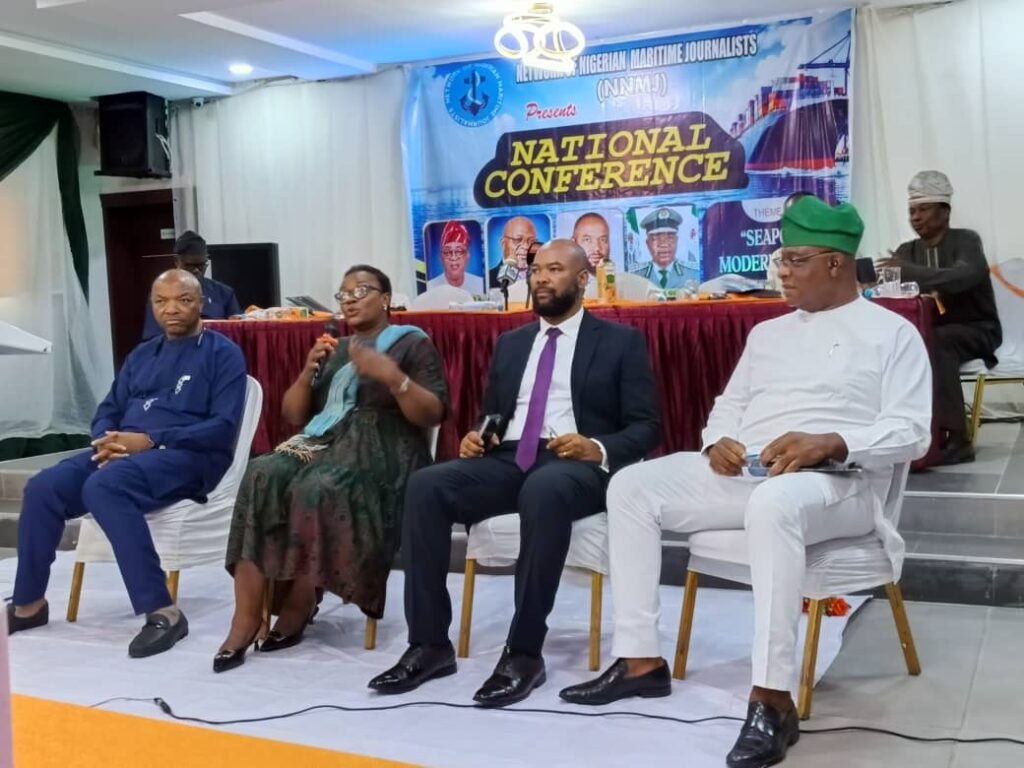
On Friday, at the Network of Nigerian Maritime Journalists (NNMJ) Unity Conference in Lagos, two of Nigeria’s most respected maritime voices stood up — and told the nation the bitter truth it has been running away from for years:
*We did not fix Apapa. We simply moved its chaos to Lekki. And our ports, as they are today, cannot carry a $1 trillion economy by 2030.*
The first warning came from a man who has led NIMASA, who knows the ports from the inside, and who now drives through Lekki every day like an ordinary Nigerian.
The second warning came from a Senior Advocate of Nigeria, armed not with sentiments, but with cold, hard numbers from the Nigerian Ports Authority (NPA), the United Nations Conference on Trade and Development (UNCTAD) and the World Bank.
Together, they shook the hall. And they left everyone in that hall with one question: *Are we building ports, or are we building new problems?*
THE HALL THAT HEARD THE TRUTH
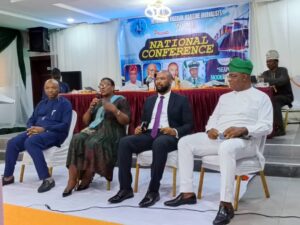
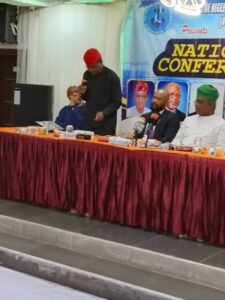
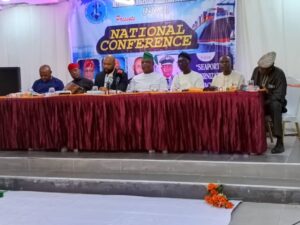
The NNMJ conference was attended by all practicing journalists in the maritime sector, as well as invited stakeholders including a retired Assistant Comptroller-General of Customs, *Charles Edike*, Chairman of Nigerian Ports Consultative Council (NPCC), *Bolaji Sunmola*, as well as President of Shippers Association of Lagos State, *Rev Nicodemus Odollo*.
They came to listen. They came to network. They came to celebrate unity.
They left with a burden.
Because what they heard was not the usual praise-singing. It was a diagnosis — and the diagnosis was serious.
OMATSEYE: “A TRUCK ALMOST SQUEEZED ME IN LEKKI”
The former Director-General of the Nigerian Maritime Administration and Safety Agency (NIMASA), *Dr Temisan Omatseye*, did not speak like a former DG. He spoke like a frustrated Lagosian. Like a father trying to get home. Like a man who has seen the same film before — only this time, the location has changed.
He said the traffic chaos that once defined Apapa has simply been relocated to the Lekki axis of Lagos, warning that the inefficiencies of the old port have followed cargo to the new Lekki Deep Seaport.
Speaking at the conference, Omatseye said the daily struggle of moving around Lekki city had become a personal ordeal, even for a short journey.
“Just to move from Marwa to Victoria Island has become a challenge. The way we used to dodge traffic in Apapa is the way we are now dodging traffic in Lekki. A truck almost squeezed me day before yesterday,” he said.
The hall went quiet. Because everyone knew he was telling the truth. Everyone in Lagos has felt it. Everyone who has tried to move from Lekki to Ajah, from Marwa to Victoria Island, from the Lekki-Epe Expressway to the city centre, knows the new nightmare.
He argued that the shift of port activity to Lekki had not solved the underlying problem.
“We have successfully transferred our inefficiencies from Apapa, and relocated it to Lekki axis.”
That one sentence captured the tragedy of Nigerian planning: We build new infrastructure, but we carry old inefficiency into it. We change the address, but we do not change the system.
Then he asked the question that every Lagosian has been asking, the question that every truck driver, every commuter, every businessman in Lekki has been asking:
“Can the trucks not go round through Ogun State to access the Lekki Port? Do they have to come to the city centre to achieve what they want?”
It was a simple question. But it exposed a monumental failure of planning — a deep seaport built without a deep evacuation plan. A $1.5 billion port, without a proper bypass, without a dedicated truck route, without a railway, without a plan to keep heavy trucks out of residential and commercial Lekki.
Omatseye also appealed to journalists to do more investigative reporting on international best practices in port operations around the world, so that lessons from other jurisdictions could inform reforms at home.
Journalists, he said, must stop reporting press releases and start reporting the world. Go to Singapore. Go to Rotterdam. Go to Dubai. Go to Busan. See how they move cargo without killing their cities. See how they build ports without destroying their roads. Bring the lessons home.
Because if we do not learn from the world, we will keep repeating Apapa — in Lekki today, in Ibaka tomorrow, in Badagry next tomorrow.
On port modernisation, Omatseye said the *Ibaka Deep Seaport in Akwa Ibom State* was coming on stream, as assurances had been given by the Presidency.
Good news, on the surface. Another deep seaport. Another gateway. Another opportunity for the South-South, for the South-East, for the North-East.
But he cautioned that the project would deliver little without supporting transport links.
“If all the cargo comes, how do we move the cargoes from Ibaka deep seaport to the North East or how do you move solid minerals from North East to Ibaka?” he asked.
Think about it: Ibaka is in Akwa Ibom. The solid minerals are in the North-East — in Bauchi, in Gombe, in Taraba, in Borno. The factories are in Kano, in Kaduna, in Aba, in Onitsha, in Lagos.
How does a container land in Ibaka and get to Maiduguri? By which road? By which rail? By which inland waterway?
If there is no answer, then Ibaka will become another beautiful port, stranded by bad logistics.
He warned that failure to address such questions would deter investment in the sector.
“If all these are not taken care of, investors would not see any reason to come and invest in our ports,” he said.
It was a warning to the Federal Government: Do not build another port and repeat the Apapa mistake. Do not build a seaport without a railway. Do not build a gateway without a road out. Do not build a $1 trillion dream on a foundation of potholes.
He also reminded the audience of the Simandou iron ore project in Guinea — where mineral resources, rail infrastructure and port development were integrated from the start. That is how serious countries do it. Port + Rail + Mine = Wealth. Port alone = White Elephant.
If Omatseye spoke from experience, *Dr Emeka Akabogu, SAN*, spoke from data. And data does not lie, does not flatter, does not beg.
Omatseye’s concerns about road congestion were reinforced by the conference keynote speaker, the maritime lawyer and Senior Advocate of Nigeria, who presented a paper titled:
“Seaports Modernisation, Trade Facilitation and Revenue Generation under President Bola Ahmed Tinubu’s Administration.”*
It was not a political paper. It was an economic X-ray.
Akabogu disclosed that approximately *90 per cent of cargo movement from Nigerian ports depends on road transport*, a situation he said places enormous pressure on port access roads, fuels congestion and undermines efficient cargo delivery.
90 per cent. In 2026. In a country dreaming of $1 trillion. In a country with 230 million people. In a country where the Apapa gridlock once became an international embarrassment.
He called for stronger rail connectivity and the development of alternative cargo evacuation channels to create a more integrated logistics system.
Rail. Inland waterways. Barges. Coastal shipping. Pipelines. Anything but 90% on roads.
Then he went into the numbers — and the numbers were devastating.
He warned that Nigeria’s ambition of building a *$1 trillion economy by 2030*, from about *$290 billion in 2025*, would need to grow by about *26.8 per cent annually* to reach the target.
Pause and think about that: 26.8% every year, for five years straight. No African economy of Nigeria’s size has ever done that consistently. And yet, that is what the target demands.
That growth must be carried by the ports. But the ports are not growing fast enough. In fact, they are growing far too slowly.
He identified a similar shortfall in general cargo. Total throughput stood at about *130 million metric tonnes in 2025* and could rise to about *230 million tonnes by 2030* if current growth persisted, but the economy’s projected expansion would require *between 330 million and 442 million tonnes*.
In other words: Even if we keep growing at our current rate, we will still be more than 100 million tonnes short. Even our best-case scenario is a failure scenario.
Vessel traffic showed the same gap, he said. Ship calls increased from *3,937 in 2022 to 4,477 in 2025*, but the current trajectory would yield only about *5,340 annual calls by 2030*, against the *10,800 to 15,300 needed*.
Nigeria needs to double — even triple — the number of ships calling at its ports. Yet the ports are still struggling to handle the ships that already come. The berths are congested. The channels need dredging. The cargo-handling equipment is ageing. The turnaround is slow.
Akabogu also pointed to prolonged vessel turnaround time as a major obstacle to competitiveness, explaining that delays raise shipping costs and the overall cost of doing business. He said the average of about *five days* at Nigerian ports should be cut to about *3.3 days* to make the ports more attractive to international shipping lines.
Every extra day a vessel spends in Nigerian waters is money lost. Every extra day is demurrage. Every extra day is a shipping line deciding to go to Cotonou, Lome or Tema next time. Every extra day is Nigeria losing competitiveness to its smaller neighbours.
He stressed the need to optimise berth occupancy, improve port connectivity and expand cargo-handling capacity, and underscored the importance of growing non-oil exports, strengthening export infrastructure and diversifying the revenue base away from crude oil.
Nigeria cannot build a $1 trillion economy on crude oil alone. Oil is volatile. Oil is finite. Oil does not employ enough Nigerians. The future is in non-oil exports — agriculture, solid minerals, manufacturing, services. But those exports need ports that work.
While acknowledging recent improvements in cargo volumes and other performance indicators, he cautioned that incremental growth would not be enough.
He called for sustained investment, effective policy implementation, regulatory certainty and clearly defined performance targets, and emphasised that credible industry data was essential for measuring performance, identifying infrastructure deficiencies and determining the scale of investment required.
Incremental growth will not save us. Only transformational growth will. Only bold, sustained, measurable investment will.
WHAT THIS MEANS FOR THE ORDINARY NIGERIAN
These are not just port numbers. These are market numbers. These are food prices. These are jobs.
When a ship waits 5 days instead of 3.3 days, the importer pays more. When the importer pays more, the market woman in Mile 12 pays more. When she pays more, you pay more for rice, for tomatoes, for spare parts, for medicine.
When 90% of cargo is on roads, trucks destroy the roads, block the roads, kill people on the roads, and raise the cost of everything that moves.
When throughput is 130 million tonnes instead of 330 million tonnes, it means factories are not producing, farmers are not exporting, miners are not mining, and youths are not working.
The port is not a faraway place in Apapa or Lekki. The port is your pocket.
The Chairman of the NNMJ, *Elder Dele Aderibigbe*, said the conference theme was deliberately chosen, stressing that the question before stakeholders was whether the nation’s ports were operating at the level required to support its economic ambitions.
He warned that countries that fail to modernise their ports risk losing cargo, investment and economic opportunities to competing maritime destinations, and called for efficient port infrastructure, faster cargo clearance, transparent procedures and effective inter-agency collaboration.
It was a warning that echoed Akabogu’s numbers and Omatseye’s experience: Modernise or lose it all. Modernise or watch Cotonou, Lome, Tema, Abidjan and Dakar eat our lunch.
What Omatseye and Akabogu said, together, is a lesson for all of Nigeria:
Do not just build a port. Build the system around the port.
Build the road. Build the rail. Build the inland waterway. Build the truck park. Build the Single Window. Build the data system. Build the regulatory certainty. Build the human capacity.
A port without a railway is a body without legs. A port without a road is a house without a door. A port without data is a blind man driving.
Lekki taught us that. Ibaka must not repeat it
Put Omatseye and Akabogu together, and the message is unmistakable:
We moved inefficiency from Apapa to Lekki. We are about to build Ibaka without a plan to move cargo. 90% of cargo is still on roads. Ship calls must triple. Throughput must more than double. Turnaround time must fall from 5 days to 3.3 days. And the economy must grow 26.8% every year.
If Nigeria does not fix its ports, fix its roads, build its rail, build its data, enforce its laws, and grow its non-oil exports, the $1 trillion dream will remain what it is today — a beautiful speech, stuck in Lekki traffic.
But if Nigeria listens to Ikeja — if it invests, if it plans, if it builds, if it measures — the ports can still become the engine of the $1 trillion economy.
The choice is ours. The time is now. The warning has been given.
History will remember whether we listened
About The Author